Introduction
Choosing a martial arts school for your child is an exciting decision. Martial arts can help young people develop discipline, confidence, coordination, focus, respect, and healthy habits. However, with so many options available, finding the right dojo can feel overwhelming.
Parents often compare class prices, locations, and schedules. Those things matter, but they are not the only factors worth considering. The difference between a good program and the right program for your child often comes down to questions that parents forget to ask before signing up.
When searching for the Best Martial Arts Schools NYC, it is important to look beyond advertisements and promises. A professional dojo should provide a safe, welcoming environment where students can learn at an appropriate pace while receiving guidance from qualified instructors.
For families exploring Martial Arts Schools in Queens NY or looking for Martial Arts Classes Near Rego Park, this guide covers the important questions to ask before making a decision.
Table of Contents
1. What Is the School’s Teaching Philosophy?
One of the first questions parents should ask is surprisingly simple:
What does this dojo want students to gain from martial arts training?
Different schools may focus on different goals. Some programs emphasize traditional martial arts values and techniques, while others may focus more heavily on competition, fitness, or self-defense.
A quality martial arts school should be able to clearly explain its teaching philosophy.
For children, a balanced program often focuses on more than physical techniques. Important areas may include:
- Respect for instructors and fellow students
- Self-discipline
- Focus and concentration
- Confidence
- Coordination and physical development
- Responsibility
- Perseverance
Ask the instructor how these values are incorporated into regular classes.
A school that simply talks about discipline in advertisements is not necessarily the same as a school that actively teaches and reinforces it during training.
Practical Tip
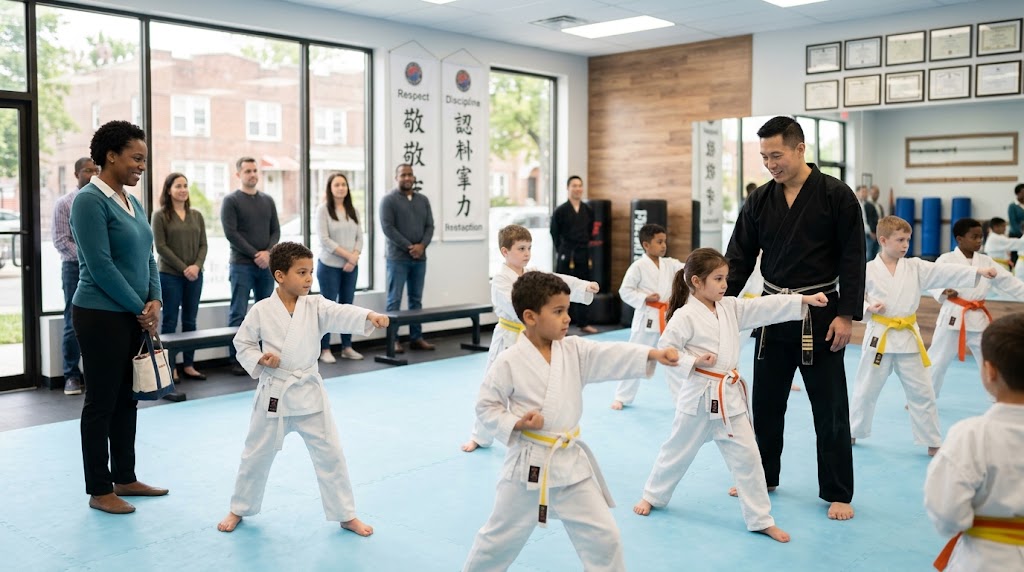
Attend or observe a class before enrolling if possible. Watch how instructors communicate with students. Are they patient? Do they provide clear instructions? Are students treated with respect?
The atmosphere inside the dojo can tell you a great deal.
2. Are the Classes Appropriate for Your Child’s Age and Experience?
Not every child learns in the same way. Age, maturity, physical ability, and previous experience can all affect how a student responds to martial arts training.
Before signing up, ask how the school organizes its classes.
Important questions include:
- Are beginners placed in classes suitable for their experience?
- Are younger and older children taught differently?
- How large are the classes?
- How much individual attention can students receive?
- Is there a structured curriculum?
The Best Martial Arts Schools NYC should have a clear approach to helping beginners feel comfortable while still providing opportunities for experienced students to progress.
A child attending their first martial arts class may feel nervous. A good instructor understands this and creates an environment where beginners can learn without feeling embarrassed.
For parents researching Martial Arts Schools in Queens NY, it is worth asking whether the program has experience teaching students in your child’s age group.
Why This Matters
A class that is too advanced may frustrate a beginner. On the other hand, a class that does not provide enough challenge may cause an experienced student to lose interest.
The goal is to find a program where your child can develop gradually and confidently.
3. How Does the Dojo Handle Safety?
Safety should always be one of the most important factors when choosing a martial arts program.
Parents sometimes assume that all martial arts schools follow the same safety standards. In reality, teaching methods, supervision, and training environments can vary.
Ask the school about its approach to safety.
Questions worth asking include:
- How are beginners introduced to new techniques?
- How closely are students supervised?
- What rules are in place for partner exercises?
- How does the instructor prevent unsafe behavior?
- What happens if a student feels uncomfortable with an activity?
A professional dojo should not make students feel pressured to perform techniques beyond their current ability.
Instructors should explain proper movement, monitor students, and encourage controlled training.
Check the Training Environment
When visiting a dojo, look around the facility.
Consider:
- Is the training area clean?
- Is there enough space for students?
- Are training surfaces properly maintained?
- Is equipment organized and appropriate for the classes?
A clean and well-organized environment often reflects the overall professionalism of the program.
4. Who Will Actually Be Teaching Your Child?
Parents often meet the person who owns or manages a martial arts school but forget to ask who will teach their child’s regular classes.
This is an important question.
Ask about the instructors’ backgrounds, teaching experience, and approach to working with children.
Martial arts knowledge is important, but teaching ability is equally valuable.
An excellent martial artist is not automatically an excellent instructor.
Children need instructors who can:
- Explain techniques clearly
- Maintain a structured class
- Encourage students appropriately
- Correct mistakes respectfully
- Adapt instruction when necessary
- Build a positive learning environment
When comparing Martial Arts Classes Near Rego Park, try to learn who will be leading the classes your child attends.
Practical Tip
If you attend a trial class, pay attention to how the instructor responds when a student makes a mistake.
Do they offer helpful guidance?
Do they remain patient?
Do students appear comfortable asking questions?
These small details can reveal a lot about the teaching environment.
5. Is There a Clear Path for Progress?
Children often stay motivated when they can see their progress.
Many martial arts programs use structured systems involving levels, ranks, or other milestones. The exact system may vary depending on the martial art and school.
Before enrolling, ask how progress is measured.
A good program should be able to explain:
- What students learn at different levels
- How advancement works
- What skills students are expected to develop
- How instructors evaluate progress
- How long-term training goals are structured
Progress should not be based only on physical ability.
For younger students, qualities such as effort, consistency, focus, and understanding may also be important parts of development.
Avoid Focusing Only on Belts or Rankings
It is natural for children to become excited about earning a new rank. However, parents should avoid choosing a school solely because advancement appears fast.
The real value of martial arts training comes from learning and development over time.
A meaningful program should encourage students to build skills gradually rather than simply rushing from one milestone to another.
6. What Are the Real Costs and Commitments?
Price is an important consideration, but parents should understand the complete financial commitment before signing up.
Ask for clear information about:
- Monthly tuition
- Registration fees
- Uniform costs
- Testing or advancement fees
- Equipment requirements
- Tournament costs, if applicable
- Contract length
- Cancellation policies
Do not feel uncomfortable asking questions.
A professional school should be transparent about its fees and enrollment policies.
Common Mistake: Looking Only at the Monthly Price
A lower monthly price does not always mean a program is the best value. Likewise, a higher price does not automatically guarantee better instruction.
Consider the complete experience.
Think about:
- Class frequency
- Instructor quality
- Student support
- Facility standards
- Program structure
- Overall learning environment
The best choice is usually the program that offers a good fit for your child’s needs and your family’s schedule.
7. Does the School Feel Like the Right Community?
Martial arts training is often more enjoyable when students feel that they belong.
A dojo can become an important part of a student’s weekly routine. That is why the community and atmosphere matter.
When visiting a school, ask yourself:
- Are new students welcomed?
- Do instructors know their students?
- Do students treat one another respectfully?
- Is the environment overly intimidating?
- Does your child appear comfortable?
A positive community can help children stay motivated and committed.
This does not mean every class should be easy. Martial arts training requires effort and discipline. However, students should feel supported while being challenged.
For families looking for the Best Martial Arts Schools NYC, the right environment can be just as important as the style being taught.
Practical Tips for Parents Choosing a Martial Arts School
Before making your final decision, use these practical tips.
1. Visit More Than One School
Try not to enroll at the first dojo you find without comparing your options.
Visiting different Martial Arts Schools in Queens NY can help you understand differences in teaching style, class structure, and atmosphere.
2. Ask About Trial Classes
A trial class can give your child an opportunity to experience the program before making a longer commitment.
Pay attention to your child’s reaction afterward.
Ask questions such as:
- Did you enjoy the class?
- Did you understand what the instructor taught?
- Did you feel comfortable?
- Would you like to return?
3. Think About Location and Schedule
Even the best program may not work well if attending regularly becomes difficult.
When searching for Martial Arts Classes Near Rego Park, consider travel time, school schedules, homework, and family responsibilities.
Consistency is important in martial arts.
A conveniently located dojo may make it easier for your child to attend regularly.
4. Speak Directly With the Instructor
A short conversation can help you understand the school’s values and expectations.
Ask what they hope students gain from training and how they support beginners.
5. Give Your Child Time to Adjust
Starting a new activity can feel unfamiliar.
Some children become comfortable immediately, while others need time to settle into a new environment.
Encourage consistency while paying attention to whether the program remains a healthy and positive experience for your child.
Common Mistakes Parents Make When Choosing a Dojo
Choosing Based Only on Price
The cheapest option is not always the right fit. Look at the complete value of the program.
Ignoring Class Size
Very large classes may make it harder for instructors to provide individual attention, especially for beginners.
Not Observing a Class
A website can provide useful information, but observing a real class can help you understand the actual teaching environment.
Focusing Only on Fast Advancement
Quick advancement may sound appealing, but meaningful skill development takes time.
Forgetting to Ask About Long-Term Commitments
Always understand contracts, cancellation policies, and additional fees before signing.
Choosing a School Without Considering Your Child’s Personality
Some children thrive in highly energetic environments, while others may prefer smaller or more structured classes.
The right program should be a good match for the individual student.
FAQ: Choosing the Best Martial Arts Schools NYC
How do I choose the best martial arts school for my child?
Start by researching local schools, visiting facilities, observing classes, and speaking with instructors. Consider safety, teaching quality, class structure, location, and whether the environment feels comfortable for your child.
What should parents look for when visiting Martial Arts Schools in Queens NY?
Look at the cleanliness of the facility, class organization, instructor communication, student behavior, and overall atmosphere. Ask questions about safety, fees, class levels, and progress.
Are trial classes important before enrolling?
Trial classes can be very helpful because they allow both parents and students to experience the teaching style and environment before making a larger commitment.
How often should children attend martial arts classes?
The ideal schedule depends on the program, your child’s age, and your family’s routine. Consistent attendance is generally more valuable than attending many classes for a short period and then stopping.
What should I ask about martial arts instructors?
Ask about their teaching experience, qualifications, approach to beginners, and experience working with children.
Are Martial Arts Classes Near Rego Park suitable for complete beginners?
Many programs welcome beginners. However, parents should confirm that the school offers appropriate instruction and support for students with no previous martial arts experience.
Should I choose a school based on the martial arts style alone?
The style is important, but the quality of instruction and the environment are also major factors. A well-run program with skilled instructors may provide a better experience than choosing based only on a particular style.
Conclusion: Finding the Best Martial Arts Schools NYC for Your Family
Choosing a dojo is about more than finding the closest location or the lowest monthly price. The right martial arts school should provide a safe environment, qualified instruction, a clear path for progress, and a positive community.
Before signing up, take the time to ask questions that many parents overlook. Observe a class, speak with the instructors, understand the costs, and consider whether the teaching style matches your child’s needs.
Families searching for the Best Martial Arts Schools NYC should focus on the complete experience rather than a single factor. The right program can give students an opportunity to develop valuable skills, build confidence, stay active, and become part of a supportive learning environment.
If you are comparing Martial Arts Schools in Queens NY or exploring Martial Arts Classes Near Rego Park, visit the dojo, ask thoughtful questions, and choose a program where your child feels encouraged to learn and grow.