Introduction: Discover Traditional Japanese Martial Arts in Queens
What makes a martial arts school the right choice? For some people, it is the opportunity to become more active. Others want to learn practical self-defense, develop greater concentration, or explore the traditions behind Japanese martial arts. Whatever your motivation, finding a training environment that matches your interests can make the journey more rewarding.
For residents exploring martial arts schools in Queens NY, there is more to consider than simply choosing a class close to home. Different martial arts develop different skills, follow different training methods, and offer unique ways to approach physical and mental development.
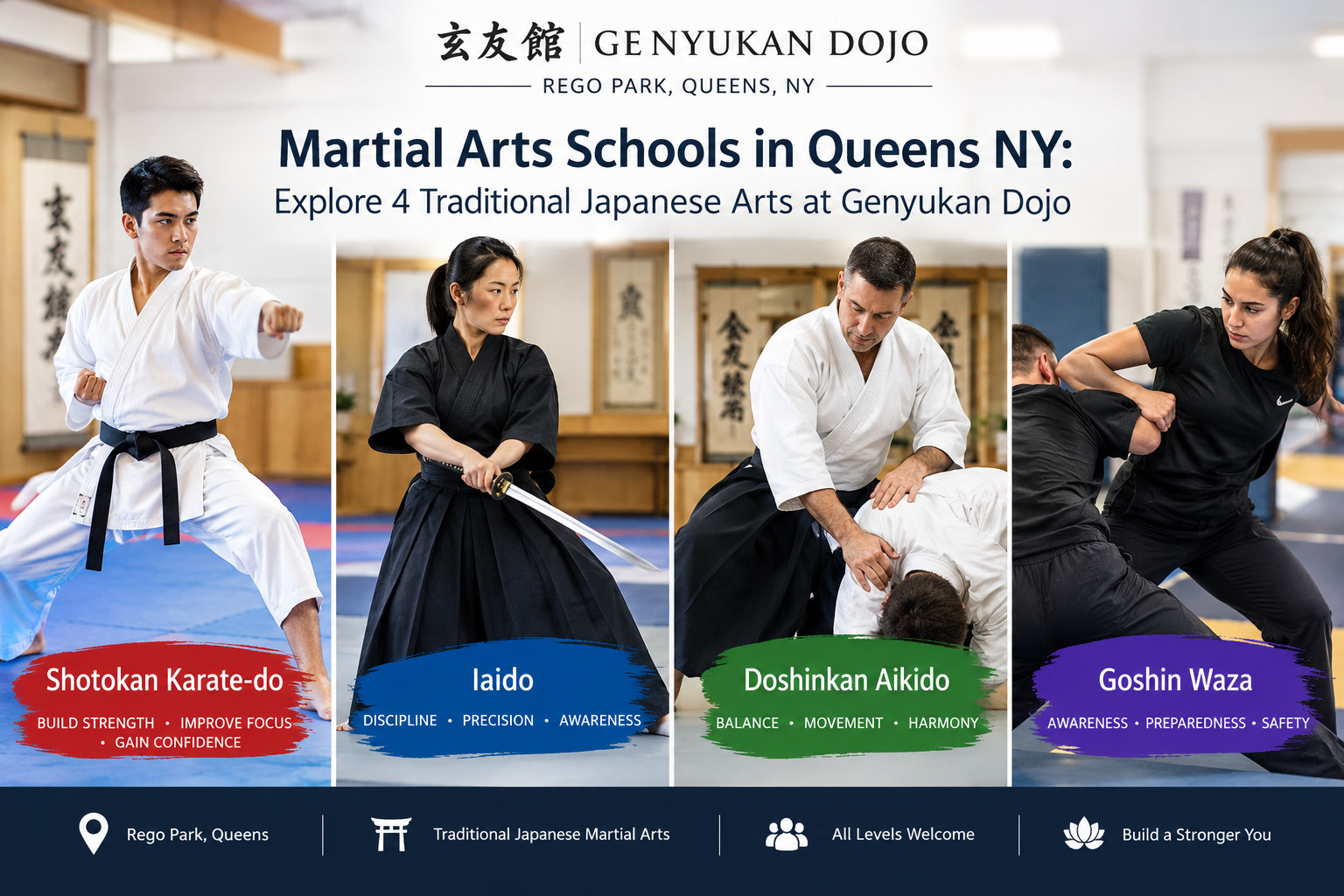
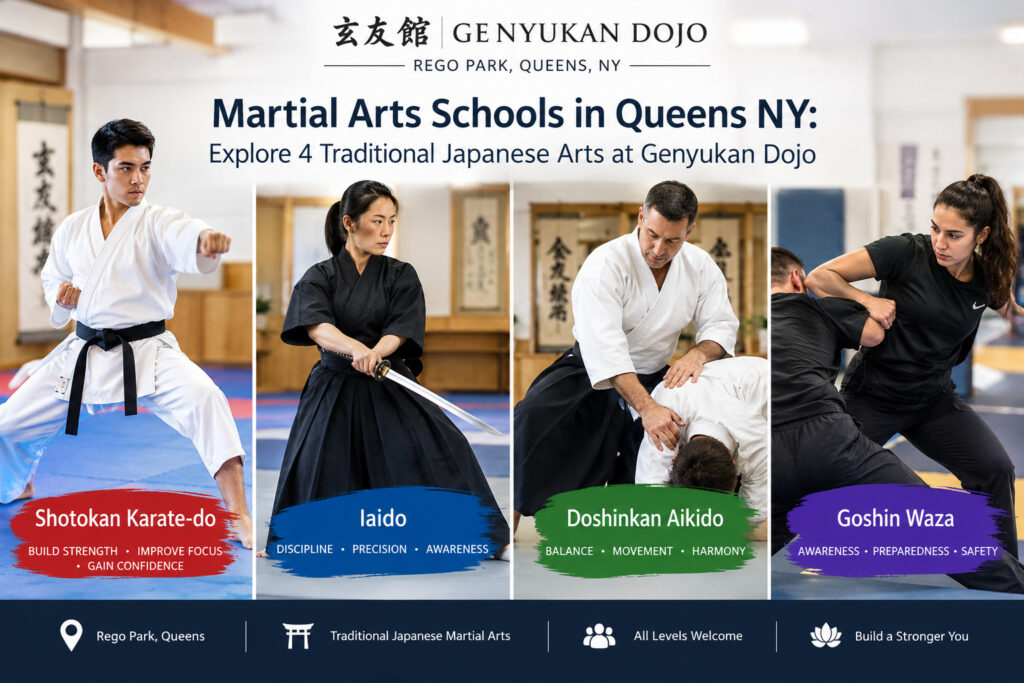
Genyukan Dojo, located in Rego Park, Queens, offers instruction in four traditional or related martial arts disciplines: Shotokan Karate-do, Ryushin Shouchi Ryu Iaido, Doshinkan Aikido, and Goshin waza self-defense. Each has a distinct focus, giving prospective students several approaches to explore.
Whether you are a beginner, an adult returning to physical activity, or a parent researching martial arts for your child, understanding these disciplines can help you make an informed decision.
In this guide, we will explore the four martial arts taught at Genyukan Dojo, explain what makes each one different, and share practical advice for getting started with training in Queens.
1. Martial Arts Schools in Queens NY: What Makes Traditional Training Different?
Traditional Japanese martial arts involve more than learning individual movements. They combine technical instruction with repetition, attention to detail, and respect for the learning process.
The Japanese term budo is commonly associated with the martial way. In traditional practice, the goal is not simply to perform a technique correctly but also to develop a better understanding of movement, timing, discipline, and personal responsibility.
These principles can make martial arts appealing to people with different interests and experience levels.
Physical development through structured practice
Martial arts classes commonly include warm-ups, fundamental movements, balance exercises, and technical drills. Depending on the discipline, students may also practice forms, partner exercises, or controlled defensive techniques.
Consistent training can help develop coordination, body awareness, mobility, and physical conditioning. The benefits depend on the frequency and intensity of practice, the student’s starting point, and the particular training program.
Unlike an unstructured workout, martial arts practice gives students specific skills to work toward. Beginners can focus on basic movements before gradually progressing to more advanced techniques.
Concentration, patience, and discipline
Learning a martial art requires attention. A student might repeat the same movement many times to improve posture, timing, or control.
This process encourages patience and helps students become comfortable with gradual progress. It also teaches an important lesson: improvement often comes from consistent effort rather than trying to master everything at once.
For children, structured instruction can provide opportunities to practice listening and following directions. Adults may appreciate the focus required to set aside everyday distractions and concentrate on learning.
Respect for tradition and training partners
Traditional dojos often have etiquette that guides how students enter the training area, greet instructors, and interact with one another.
These customs help establish a shared learning environment. Respect also means practicing responsibly, following safety instructions, and recognizing that every student develops at a different pace.
When comparing martial arts schools in Queens NY, consider whether the school’s teaching approach and expectations align with the kind of environment you want.
2. Shotokan Karate Queens NY: Learn the Fundamentals of Karate
Shotokan Karate is a Japanese martial art known for its structured approach to striking techniques, stances, movement, and formal practice.
For people interested in Shotokan Karate Queens NY, understanding the basics of training can help clarify what to expect from a class.
At Genyukan Dojo, Shotokan Karate-do is one of the central traditional martial arts programs. Students develop their skills through systematic practice, with an emphasis on learning fundamental techniques before progressing.
Kihon: Building a strong foundation
Kihon means fundamentals or basics. Students practice movements such as punches, blocks, kicks, and stances.
These exercises help develop coordination, stability, and control. Beginners may find that seemingly simple techniques require considerable attention to posture and positioning.
The purpose is not to rush through the movements. It is to develop a reliable foundation that can support more complex training later.
Kata: Practicing sequences of techniques
Kata are prearranged sequences of movements that represent specific techniques and transitions.
Practicing kata helps students work on balance, coordination, direction, timing, and precision. It also provides a structured way to review techniques outside partner-based exercises.
As students gain experience, they can develop a deeper understanding of the movements and the principles behind them.
Kumite: Learning through partner practice
Kumite refers to partner practice, which may include controlled sparring or structured exercises depending on the level and training method.
Students learn to manage distance, recognize movement, maintain control, and respond appropriately to a training partner.
Safety and supervision are essential, particularly for beginners. Students should understand the rules and expectations before participating in more demanding exercises.
If you are considering karate classes, ask about the school’s beginner program, progression system, and approach to partner training.
Explore the Shotokan Karate program at Genyukan Dojo to learn more about this discipline.
3. Iaido New York: Explore the Traditional Japanese Art of Sword Drawing
For people interested in Japanese martial traditions beyond unarmed techniques, Iaido offers a distinctive form of practice.
Iaido focuses on the controlled drawing of a Japanese sword, the performance of prescribed techniques, and the return of the sword to its scabbard. Training typically emphasizes precision, posture, awareness, and deliberate movement.
Genyukan Dojo teaches Ryushin Shouchi Ryu Iaido, a traditional Japanese sword art with its own established forms and training methods.
Precision matters more than speed
A common misconception is that sword training is mainly about moving quickly. In Iaido, students must pay attention to many details, including body positioning, grip, coordination, and the sequence of movements.
Learning these details takes time. Practitioners usually begin with foundational instruction and gradually develop their understanding under the guidance of an instructor.
The goal is to perform each movement with appropriate control and accuracy rather than simply to move faster.
Understanding kata in Iaido
Iaido practice commonly centers on kata, which are prescribed sequences performed according to the principles of the particular school.
Each form gives students an opportunity to work on movement, timing, posture, and mental focus. Repetition allows practitioners to identify small inconsistencies and improve their technique over time.
The formal nature of this practice can appeal to people who enjoy detailed study and a methodical learning process.
Is Iaido suitable for beginners?
Iaido can be an option for beginners who are interested in traditional Japanese sword arts. Previous martial arts experience may be useful, but prospective students should ask the instructor about the school’s entry requirements.
Because Iaido involves sword-related training, following equipment guidelines and safety procedures is especially important. Beginners should use only the equipment approved by their instructor and should never attempt sword techniques independently without proper instruction.
If you are researching Iaido New York, consider the specific style being taught, the instructor’s background, and how introductory classes are structured.
Learn more about Ryushin Shouchi Ryu Iaido at Genyukan Dojo.
4. Doshinkan Aikido: Develop Movement, Balance, and Control
Aikido provides another way to explore Japanese martial arts. Rather than focusing primarily on striking, Aikido training emphasizes movement, positioning, balance, and techniques that respond to another person’s actions.
Genyukan Dojo offers Doshinkan Aikido as part of its martial arts instruction.
Learning to move with awareness
Aikido practice can include footwork, turning movements, balance exercises, and partner-based techniques.
Students learn to pay attention to distance and positioning while coordinating their movements with those of a partner. This requires patience because the quality of a technique depends on more than strength alone.
Developing these skills can improve body awareness and provide a different perspective on how movement works in martial arts.
Partner practice and responsible technique
Many Aikido exercises involve working with another student. This makes communication, control, and respect especially important.
Students should follow the instructor’s guidance and learn techniques progressively. Joint techniques and falls must be taught and practiced appropriately, with attention to each person’s ability and comfort.
A good class environment encourages students to ask questions and communicate when a movement feels unfamiliar or uncomfortable.
Who might enjoy Aikido?
Aikido may appeal to people who are interested in traditional Japanese martial arts, coordinated movement, and partner-based learning.
As with any discipline, the best way to determine whether it suits you is to understand the teaching approach and observe or attend a suitable introductory class.
If you are comparing different martial arts schools in Queens NY, ask how Aikido classes are structured and what beginners can expect during their first few sessions.
5. Goshin Waza: Understand the Principles of Self-Defense Training
Goshin waza refers to self-defense techniques. At Genyukan Dojo, this training complements the school’s traditional martial arts offerings.
Self-defense education can help students think more carefully about personal safety, movement, and how to respond to potentially threatening situations.
However, practical self-defense involves much more than memorizing physical techniques.
Awareness and decision-making come first
A useful approach to personal safety includes recognizing warning signs, maintaining awareness of your surroundings, setting boundaries, and avoiding unnecessary confrontations when possible.
Physical techniques are only one part of a broader set of skills. In some situations, creating distance, leaving the area, or seeking assistance is safer than attempting to engage with an aggressor.
Training should reinforce realistic decision-making rather than suggest that a particular technique will work in every circumstance.
Learning physical responses progressively
Depending on the curriculum, self-defense training may involve movement, positioning, defensive responses, and controlled partner exercises.
Students should receive clear instructions about how techniques are practiced and how risks are managed. Exercises need to be appropriate to the participants’ experience levels.
Beginners should not feel pressured to perform advanced techniques or participate in exercises they do not understand.
Choosing self-defense classes in Queens
If your main interest is self-defense, ask a prospective school what the program covers.
Useful questions include:
- Does the training address awareness and avoidance as well as physical techniques?
- Are partner exercises supervised?
- How are techniques adapted for beginners?
- What safety rules are used during practice?
- How does the instructor explain the limitations of physical self-defense?
The answers can help you decide whether the program matches your expectations.
Remember that martial arts training cannot guarantee personal safety. Its value depends on the instruction, practice, and decisions students make in real situations.
6. How to Choose Among Martial Arts Classes Near Rego Park
When comparing martial arts classes near Rego Park, consider more than the name of the discipline. Your schedule, goals, preferred learning style, and comfort with the training environment all matter.
A school that is convenient and enjoyable to attend may make it easier to build a consistent routine.
Match the discipline to your interests
If you want to study traditional striking techniques and kata, Shotokan Karate may be a good starting point.
If you are fascinated by Japanese sword traditions and precise formal movements, consider Iaido.
If you prefer to explore balance, positioning, and partner-based techniques, Aikido may interest you.
If your priority is learning about personal safety and defensive responses, ask about Goshin waza and the school’s self-defense curriculum.
You do not need to know exactly which discipline is right for you before visiting a dojo. Asking questions and learning about each program can help you make an informed choice.
Evaluate the instructor and training environment
Look for an instructor who explains techniques clearly, gives constructive feedback, and prioritizes safe practice.
The environment should be respectful and organized. Beginners should have opportunities to ask questions and understand what is expected of them.
It is also useful to ask how students progress, whether classes are separated by age or experience, and what equipment is required.
Make sure the schedule works for you
Consistency matters more than choosing a schedule that looks ideal on paper but is difficult to maintain.
Review the current Genyukan Dojo class schedule and contact the school to confirm which sessions are available for your age and experience level.
Understand costs before joining
Ask about membership fees, introductory offers, uniforms, grading costs, and any equipment you may need later.
The school’s frequently asked questions page provides additional information about becoming a student and preparing for training.
Before making a commitment, confirm current prices and membership terms directly with the dojo.
7. Practical Tips for Beginners and Common Mistakes to Avoid
Starting a martial art does not require years of experience or expensive equipment. A few practical steps can help you approach your first class with confidence.
Before your first class
Identify your goal. Decide whether you are most interested in karate, sword arts, Aikido, self-defense, or general personal development.
Contact the school. Ask about introductory sessions, class times, clothing, and equipment requirements.
Arrive early. Give yourself time to meet the instructor and understand the dojo’s basic etiquette.
Be honest about your experience. Tell the instructor whether you are completely new or have trained in another martial art.
Ask about safety. Make sure you understand the instructions before attempting unfamiliar movements.
During your first few weeks
Focus on learning the fundamentals instead of comparing yourself with experienced students. Progress looks different for everyone, and some techniques take longer to understand than others.
Attend consistently at a manageable pace. If a movement causes pain or feels unsafe, stop and speak with your instructor.
Pay attention to feedback, and remember that correction is a normal part of learning.
Common mistakes beginners should avoid
1. Choosing a martial art only because it looks impressive. Videos and demonstrations can be exciting, but the day-to-day training experience is what matters. Learn about the curriculum before deciding.
2. Expecting instant mastery. Martial arts involve repetition and gradual improvement. Set realistic goals and give yourself time to develop.
3. Buying equipment before asking the instructor. Equipment requirements vary between disciplines. Wait until you understand what is appropriate for your class.
4. Training too intensely at the beginning. Trying to do everything at once can lead to fatigue and frustration. Build your routine gradually.
5. Ignoring the importance of regular attendance. Occasional classes can make it harder to retain techniques. Choose a realistic schedule that you can follow consistently.
6. Treating martial arts as a guarantee of self-defense. No technique works in every situation. Awareness, judgment, avoidance, and appropriate help remain important parts of personal safety.
The best starting point is simple: choose a discipline that interests you, find an instructor you trust, and approach each class with patience.
Frequently Asked Questions About Martial Arts Schools in Queens NY
What martial arts does Genyukan Dojo teach?
Genyukan Dojo offers Shotokan Karate-do, Ryushin Shouchi Ryu Iaido, Doshinkan Aikido, and Goshin waza self-defense training. Contact the school to confirm the current availability of each program.
Are there martial arts classes near Rego Park for beginners?
Genyukan Dojo is located in Rego Park, Queens, and welcomes prospective students interested in exploring its programs. Contact the dojo to confirm which introductory classes are currently available and whether you need to arrange a visit.
What is the difference between Shotokan Karate and Iaido?
Shotokan Karate focuses on striking techniques, stances, kata, and partner practice. Iaido centers on controlled sword-drawing techniques and prescribed forms. Both emphasize discipline and technical development, but their training methods and equipment differ.
Can adults start learning martial arts without experience?
Yes. Adults can begin learning martial arts without previous experience. Choose a suitable beginner class, explain your goals to the instructor, and progress at a manageable pace.
Which martial art is best for self-defense?
There is no single best option for every person or situation. The value of a program depends on its curriculum, teaching quality, supervised practice, and relevance to realistic safety concerns. Look for instruction that addresses awareness, avoidance, decision-making, and appropriate physical responses.
What should I wear to my first martial arts class?
Ask the school before attending. Comfortable athletic clothing may be suitable for an introductory session, while regular classes may have uniform requirements. Follow the instructor’s advice before purchasing equipment.
Where is Genyukan Dojo located?
Genyukan Dojo is located at 63-44 Saunders Street, Rego Park, NY 11374. You can call +1 347-642-3447 or visit the official Genyukan Dojo website to ask about programs and scheduling.
Conclusion: Find Your Path at Martial Arts Schools in Queens NY
Exploring martial arts schools in Queens NY is an opportunity to discover a discipline that matches your interests, goals, and preferred way of learning.
Shotokan Karate offers structured practice in striking techniques and kata. Iaido introduces students to the traditional Japanese art of sword drawing. Doshinkan Aikido emphasizes movement, balance, and controlled partner techniques, while Goshin waza provides a self-defense-focused approach.
Each discipline has its own character, and the right choice depends on what you want to learn and how you prefer to train.
For residents of Rego Park and surrounding Queens neighborhoods, Genyukan Dojo offers a local place to explore these four martial arts disciplines. Prospective students can review the programs, check the class schedule, and contact the school to discuss introductory training.
Rather than trying to find a perfect style on your first attempt, begin by learning about your options and speaking with an instructor. A visit can help you understand the training environment, ask questions, and decide whether the program feels right for you.
Ready to explore traditional Japanese martial arts in Queens? Visit Genyukan Dojo to learn about the available programs and take the first step toward your martial arts journey.